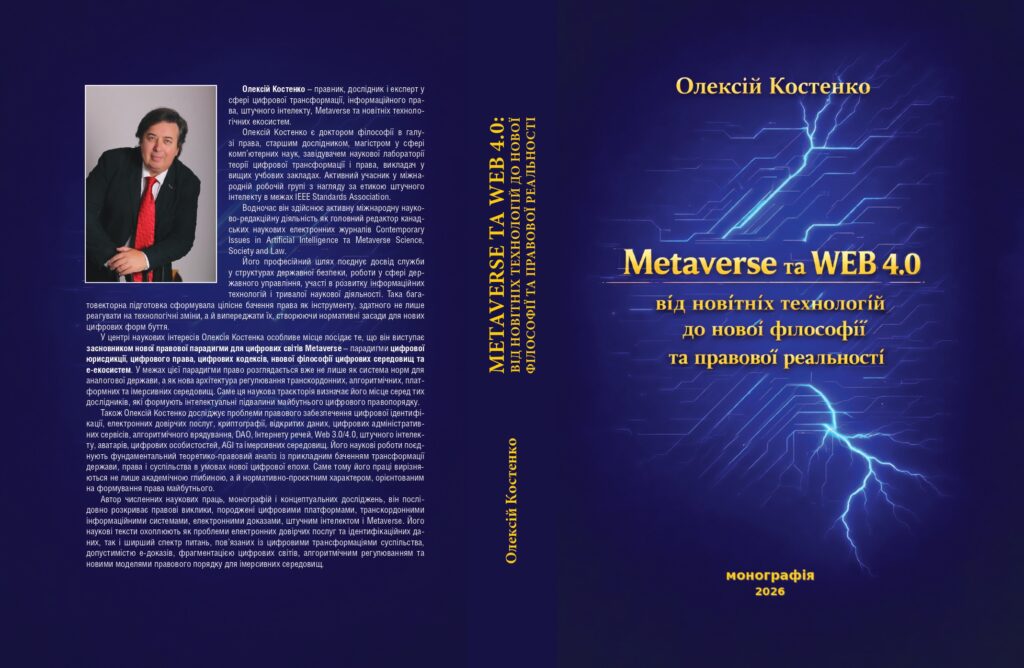
Law has never existed in isolation from the way human society is organized. It emerged together with cities, changed together with states, and developed together with markets and technologies. Every technological revolution — from printing to industrialization, from the telegraph to the global Internet — has transformed not only the means of production or communication, but also the very architecture of the normative order, rethinking the categories of property, responsibility, jurisdiction, and sovereignty. The challenge faced by legal science in connection with the development of immersive technologies is not merely another challenge of “new technologies” to which law has become accustomed to adapting. It is a challenge of a different order. Previous technological revolutions changed the forms of human activity, but did not affect the fundamental premises of law: the human being remained the sole bearer of legally significant will; the state remained the only legitimate norm-maker; territory remained the basis of jurisdiction. Immersive technologies, artificial intelligence, and decentralized networks are undermining all three premises simultaneously. Thus, legal science is confronted with a fundamentally new vector of development: the need to formulate a normative model capable of encompassing not only human conduct in physical space, but also the interaction of subjects within digital ecosystems, where the boundaries of territory, time, and materiality undergo radical rethinking. New subjects, new forms of assets, and new risks require a qualitatively different legal mindset — systemic, interdisciplinary, and project-oriented. Humanity is entering a phase of profound digital transformation, in which artificial intelligence, blockchain infrastructure, immersive technologies, and decentralized networks are forming a qualitatively new level of social reality. The Metaverse and Web 4.0 are emerging not as a futuristic metaphor, but as a functional space for economic activity, governance, education, justice, and security. In this environment, virtual assets with real value are created; autonomous algorithmic systems operate; digital avatars and digital identities interact and acquire legal significance. The traditional model of law, formed within the coordinates of territorial jurisdiction, public authority, and hierarchically structured institutions of industrial statehood, increasingly demonstrates its limitations when confronted with algorithmic processes, autonomous agents, and transnational digital platforms. Normative constructs designed for the physical presence of a subject, the material circulation of things, and clearly defined state borders are now confronted with the reality of decentralized networks, in which decisions are made by code and economic activity is carried out in distributed ledgers. The ontology of legal relations itself is changing. Digital identity is ceasing to be merely a technical attribute of access to services and is gradually acquiring the features of a legal institution that mediates a person’s participation in virtual transactions, voting in DAO structures, and the management of digital assets. Virtual assets are gaining economic and investment significance, influencing financial markets and tax models, while algorithmic systems are being increasingly integrated into managerial decision-making, judicial procedures, security mechanisms, and educational processes. In such a configuration, what is needed is not targeted legislative amendments, but the formation of a new normative architecture capable of ensuring legal certainty, predictability, and responsibility in an environment that functions beyond classical territorial boundaries. This entails a transition from reactive regulation to the strategic design of a digital legal order, in which jurisdiction, sovereignty, and legal personality are understood through the prism of networked and algorithmic reality. At the center of this monograph lies a question that legal science has long avoided formulating directly: is contemporary law capable of regulating relations in which the human being is no longer the sole source of legally significant action? An algorithm makes a decision. A smart contract is executed automatically. A digital agent acts within a predefined scenario without any human intervention. Who bears responsibility? Under which jurisdiction? On the basis of which norm? These are not rhetorical questions; they are already arising today before courts, regulators, and practicing lawyers who have no answers to them. The monograph does not evade these questions; it builds its entire conceptual construction upon them. It begins with what legal research does not often begin with: a rethinking of the ontological foundations of law. It asks what, in general, constitutes a subject, an object, and a legal fact in an environment where legal consequences arise not through an act of human will, but through the logic of software code. The rethinking of anthropocentrism in law proposed in these pages is not a rejection of humanism. Paradoxically, it is its highest manifestation: protecting the human being in an environment where decisions are made by algorithms is impossible unless one first recognizes that classical constructs of subjectivity, guilt, and causation simply do not work here. The monograph was written in Ukraine during 2022–2026, and this temporal continuum imposed its harsh realities. Digital sovereignty, discussed on these pages, is not an academic category under conditions of hybrid warfare and information attacks, but a practical dimension of state security. At the same time, Ukraine, which is now shaping its position on digital law in the process of European integration, has grounds to claim not only the adaptation of foreign models, but also the role of an active participant in the formation of a pan-European digital legal order. The purpose of the study is to form a coherent, scientifically grounded doctrine of digital jurisdiction based on information law, aimed at the theoretical and legal comprehension and systemic substantiation of mechanisms of public-law regulation of social relations that arise, transform, and function in digital and virtual environments, including the Metaverse/Web 4.0, as a new form of organization of the information sphere. Although the title of the study formally points to two phenomena, the work substantiates that the Metaverse and Web 4.0 are not two independent subjects, but constitute a single conceptual construction existing in two interconnected dimensions: the substantive dimension, which is socio-economic and anthropological, and the normative-architectural dimension, which is legal and technological. This approach makes it possible to consider them as two projections of one polystructural sociotechnical phenomenon, which possess relative autonomy but are incapable of functioning in isolation. The purpose of the study is to form a coherent doctrine of digital jurisdiction as a legal mechanism for the systemic regulation of social relations in the Metaverse/Web 4.0 environment under the conditions of Ukraine’s European integration. Achieving this purpose entails identifying patterns in the transformation of the information sphere under conditions of digitalization and immersive technologies; determining the place of the Metaverse/Web 4.0 within the system of information space; rethinking classical notions of jurisdiction, public authority, and legal regulation; revealing the content and structure of information-law relations involving the state, digital platforms, and new digital subjects; substantiating digital jurisdiction as a post-territorial form of the exercise of public authority; defining the legal regimes of information resources and technologies and their role in ensuring information security and protecting the rights of subjects; and developing scientifically grounded proposals for improving legislation with due regard to international practices. The scientific novelty of the study lies in the formation of a coherent doctrinal model for the legal comprehension of digital reality, based on the integration of the Metaverse and Web 4.0 into a single polystructural subject of research and a new type of jurisdictional environment. For the first time, the study systematically substantiates a new subject composition of digital legal relations, including digital personalities, avatars, algorithmic agents, and decentralized autonomous organizations, as well as new objects of legal regulation, including digital assets, tokenized resources, digital twins, and the results of artificial intelligence activity. The study develops the concept and model of digital jurisdiction as a post-territorial form of exercising public authority based on the technological localization of legally significant actions. It also proposes a model of digital law as an integrated normative system combining legal norms, algorithmic mechanisms, and protocol-based regulation. A new philosophical and legal basis of the Metaverse/Web 4.0 is formulated, reflecting the transition from an anthropocentric to a post-anthropocentric paradigm of law and to the concept of metasubjectivity. Strategic directions and formats are proposed for the development of legal regulation of digital environments for Ukraine under conditions of European integration, including legislative adaptation, the formation of digital sovereignty, and integration into the European legal space. Digital jurisdiction is proposed as an alternative to the territorial principle, which has long ceased to cope with cross-border digital relations: instead of attachment to a state, attachment is made to technological infrastructure, to the architecture of a platform, and to identification protocols. The concept of digital jurisdiction is proposed as the system-forming basis of the digital legal order, intended to rethink the very nature of powers of authority and the limits of the state’s normative influence under conditions of networked reality. Digital jurisdiction is considered not as a technical supplement or a service add-on to the existing system, but as a new format for organizing legal space, within which procedural legitimacy, algorithmic transparency, digital identification of subjects, and institutional responsibility for decisions made by both humans and intelligent systems are combined. Jurisdiction is no longer reduced exclusively to territorial attachment; it acquires a networked dimension capable of functioning in distributed environments where transactions are carried out through smart contracts, managerial decisions are made by algorithms, and interaction among subjects takes place in immersive spaces. Digital jurisdiction is intended to ensure legal interoperability between analog statehood and digital ecosystems by integrating mechanisms of control, verification, and responsibility into the very architecture of digital platforms. Thus, what is at stake is the formation of a new normative matrix in which innovation is not opposed to legal protection, but coexists with it within a balanced system of guarantees, procedures, and standards. It is precisely through digital jurisdiction that the possibility opens for moving from fragmented regulation of individual technologies to the holistic design of the digital legal order of the future. The subject of the discourse also includes the position on code-based regulation — software code as an independent normative regulator that already establishes rules, determines sanctions, and ensures their enforcement without the participation of a court or the state. The monograph proposes not to ignore this fact, but to include it within the legal system: to recognize it, legitimize it, establish its limits, and subject it to public control. The realism of this book is not a reason to fold one’s arms. On the contrary: every diagnosis is followed by a prescription. Every identified gap is followed by a proposal to fill it. Regulatory sandboxes, preventive digital norm-making, phased codification of digital law, a risk-oriented regulatory model, distributed legal responsibility in decentralized environments, and the conceptual foundations of a digital code — all this is not utopia, but pragmatics based on a deep understanding both of the nature of the technologies themselves and of the limits of legal regulation as such. A special place here is occupied by the concept of the state-as-architect: a state that does not try to prohibit what it cannot stop, but consciously forms the legal and technological frameworks within which digital space develops in accordance with public values and human rights. The monograph pays special attention to the formation of digital codes as a modular, architecturally structured model for the systemic normativization of the Metaverse. This is not about mechanically compiling individual norms into a collection, but about creating a structured normative ecosystem capable of integrating the regulation of virtual assets, digital identities, artificial intelligence activity, DAO mechanisms, smart contracts, and transnational platforms into a single logic of legal order. Digital codes are considered as an instrument for designing the future legal environment, in which rules are embedded with due regard to the technical architecture of platforms, algorithmic transparency, and mechanisms of automated execution. They are intended to ensure not only normative certainty, but also the technological compatibility of legal solutions with digital infrastructures. This approach makes it possible to move from fragmented responses to individual technological challenges toward the strategic construction of the legal order of the digital age — an order in which the state does not merely chase innovations, but shapes their normative boundaries and development guarantees. The monograph also organically combines philosophical and legal reflection with applied regulatory models, making it possible to consider digital transformation not merely as a technical process, but as a profound change in the structure of legal reality. It analyzes the social and legal implications of algorithmic autonomy, the transformation of the boundaries of responsibility of intelligent systems, the problematics of digital sovereignty, and the challenges of harmonizing the national regulatory approach with European and global trends in the development of digital law. Separate emphasis is placed on the fact that the legal response to artificial intelligence, decentralized platforms, and immersive environments requires a new methodology — one that takes into account the interaction between technological architecture, ethical standards, and normative constructs. In light of the foregoing, digital transformation appears not as an episode of modernization or another stage of legislative reform, but as a civilizational rupture within which law must rethink its own categories, principles, and instruments of influence. The first chapter of the monograph is devoted to the formation of the fundamental theoretical basis of the study, within which the Metaverse is considered not as a technological platform, but as a new legal reality with its own ontology, subjectivity, and normative logic. The second chapter focuses on the analysis of the technological foundations of the Metaverse as a prerequisite for the formation of new legal regimes. It examines Web 4.0 architectures, the role of the Internet of Things as an integrative component of digital environments, and the functioning of decentralized autonomous organizations (DAOs) as new institutional forms of digital interaction. The third chapter reveals the legal aspects of managing digital assets, identification data, and legal personality in virtual environments. The central place is occupied by the study of identification data as a basic element of legal interaction, as well as by the analysis of blockchain technologies as an instrument for ensuring trust, transparency, and the cross-border nature of digital legal relations. The fourth chapter is conceptual and philosophical in character and is aimed at forming the worldview foundations of Metaverse law. It substantiates six postulates of the scientific theory of the development of law in the Metaverse and reveals a new philosophy of digital reality that goes beyond classical anthropocentrism. The author proposes a post-anthropocentric approach in which law adapts to the existence of digital subjects and autonomous systems. The fifth chapter serves as the culminating element of the study, since it formulates applied models of digital jurisdiction as a new form of exercising public authority in the digital environment. The book is addressed to a wide range of readers, and each will find something of their own in it. The researcher will find a conceptual system with a clear terminological apparatus and the author’s definitions of the basic categories of digital law. The legislator will find practical models ranging from regulatory sandboxes to the foundations of a digital code. The university lecturer will find the possibility of creating new educational and scientific disciplines in the architecture of law or digital legal modules. The judge and legal scholar will find an analysis of institutions that are already malfunctioning in the digital environment. And — perhaps most importantly — the book is addressed to the reader who already senses that something essential has changed in the legal space, but does not yet have the language to name it. This monograph offers such a language. There is an old debate in legal science: is law a mirror of society, merely reflecting what already exists, or is it an instrument for designing what society ought to become? This monograph unequivocally chooses the second position and argues for this choice consistently, from the first page to the last. Metaverse law cannot be reactive. It cannot wait for disaster and only then begin to formulate answers. Preventive norm-making, discussed in this book, is not about restricting technologies. It is about preserving democratic control under conditions in which technologies develop faster than institutions.